
, 7 min de lectura
Fire on a composting site: understanding the risk and detecting it in time
Fire is the main risk on composting sites. In its latest review dedicated to composting, published in May 2018, the BARPI (the French Ministry of Ecological Transition’s accident analysis office) analysed 124 accidents in France: 115 were fires. More recent figures point the same way. Most often, the fire does not come from outside but from the core of the pile, through self-heating. This article explains how such a fire develops, which situations increase the risk, and what continuous temperature monitoring makes it possible to anticipate.
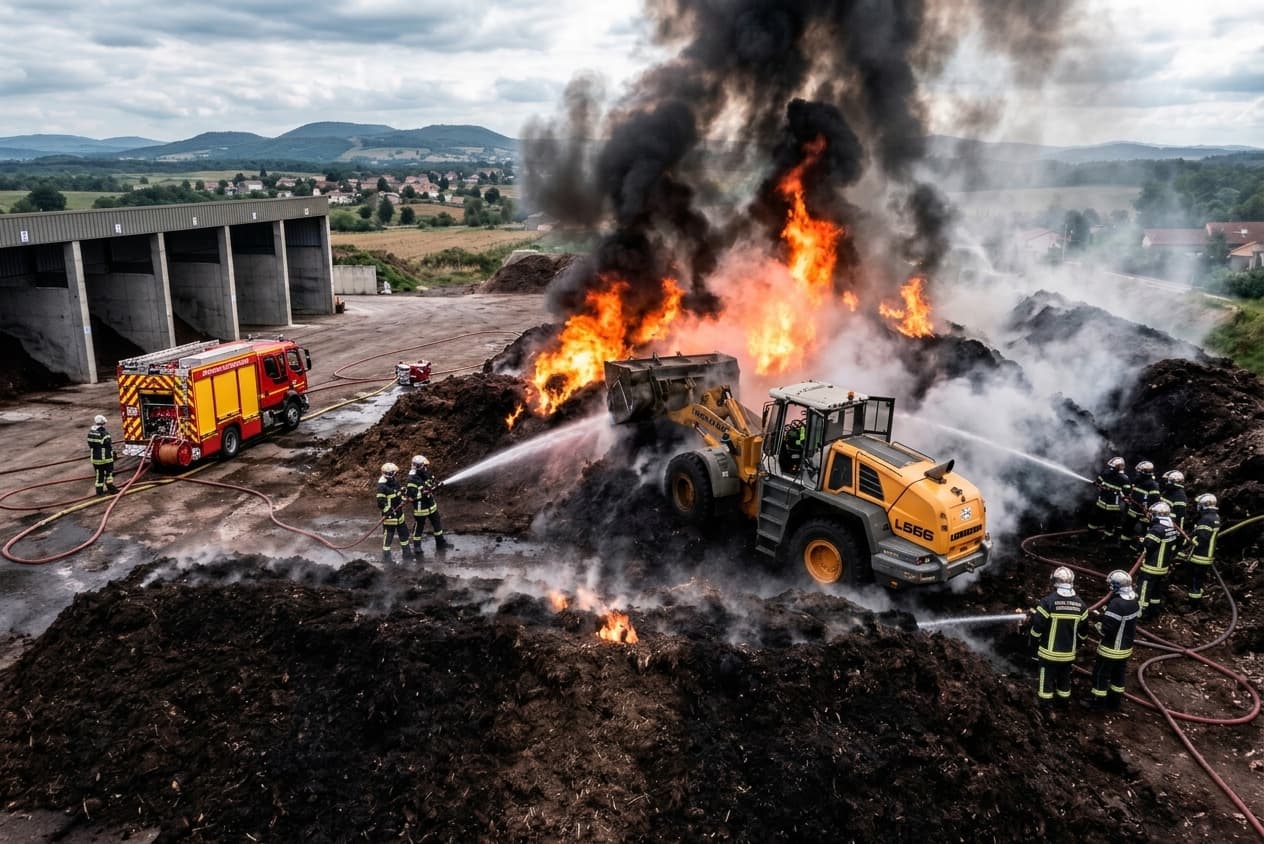
The main risk on a composting site
The BARPI review covers accidents involving a composting activity recorded in the ARIA database up to the end of 2017: 124 accidents, half of them between 2013 and 2017. 115 of them are fires, or 93%.
For the 60 fires whose origin is known or suspected, the most frequent cause lies in the process itself: almost half (48%) result from runaway self-heating. Next come malicious acts (37%) and external hazards such as extreme heat, strong wind or lightning (35%). Equipment failures on shredders, screens or conveyors (12%) and human error (8%) are less common. A single fire can have several causes, which is why the total exceeds 100%.
No deaths or serious injuries were recorded, but the consequences are still heavy. Smoke sometimes forces residents to shelter or evacuate, and firefighting water has to be treated. When more than 10,000 m³ of waste is involved, the intervention often lasts several days. In the costliest cases, losses reach €0.4 to €1 million.
The risk has not decreased since. In its inventory of 2022 accidents, the BARPI notes that the number of events at composting sites doubled in one year, from 14 in 2021 to 28 in 2022, all of them fires. In 2025, waste treatment was the sector with the most accidents and incidents among classified installations (16% of events), and the French Ministry of Ecological Transition made fires in waste management sites a national priority.
How a pile catches fire from the inside
Heat is part of composting: the microorganisms that break down the material give it off. It is even required, since permitted sites in France must reach at least 55 °C for a total of 72 hours (order of 22 April 2008). According to the BARPI, 50 to 70 °C is ideal during the thermophilic phase.
The problem starts when the pile produces more heat than it releases. The temperature then keeps rising. At around 80 °C, chemical oxidation takes over from biological activity, and it speeds up as the temperature rises. The pile can reach 150 to 200 °C with no external source: this is spontaneous combustion.
The fire first smoulders, without flames, at the core of the pile. It is hard to see, and water penetrates the mass poorly. When the pile is opened or the wind aerates it, the sudden supply of oxygen can bring out flames.
Situations that increase the risk
The BARPI lists several factors: the composition of the materials, their moisture, the size of the pile, the ambient temperature, air circulation and storage time. Moisture plays a central role. Material at 20 to 45% moisture favours self-heating, whereas composting works best between 40 and 55%. Mature compost and screening rejects, which are drier, are therefore the most exposed. Unevenly distributed moisture is also a problem: rain on a dry windrow can restart the heating.
Pile size and storage time come next. The higher a pile, the more heat it holds. French regulations for composting sites therefore limit piles of fermentable material to 3 m high (5 m by exemption) during fermentation and maturation. In one fire (ARIA 47656), compost was stacked 8 m high instead of the authorised 2.5 m. Storage for weeks or months without handling increases the risk in the same way.
Weather makes these situations worse: heatwaves and drought dry out the piles, strong wind oxygenates them. Regions in the south of France are over-represented in the accidents. In 2022, the hottest year in France since 1900, the rise in composting events was largely linked to the heat: 10 events caused by natural hazards, against 1 in 2021.
Finally, lack of monitoring comes up again and again. In Torcy in 2021 (ARIA 57466), a green waste windrow caught fire: it had not been turned when scheduled, and its temperature was not being measured. Since sites are rarely staffed around the clock, many fires break out at night or at weekends and are discovered by a neighbour or a third party.
What lessons learned recommend
The BARPI concludes that simply complying with regulations would have prevented a large share of these fires, especially those caused by loss of process control. Recent inspections show that the basics are still often missing: in 2025, the Occitanie regional environment authority carried out 70 unannounced inspections of waste management sites and found 294 non-compliances, including missing or poorly maintained extinguishers and detectors, and fire defence plans that were missing or inadequate at around forty sites.
Its recommendations first concern how piles are managed: complying with authorised heights and volumes, splitting stocks into spaced batches, reducing storage time without handling, turning windrows more often and evening out moisture after heavy rain.
They then concern monitoring. The BARPI advises measuring temperature more often than the regulatory minimum, and even more during hot spells or after heavy rain. It also recommends training operators to spot smouldering fires: white fumes, smell of burning, temperature probes pushed deep into the piles. Above 80 °C or when fumes appear, the pile should be opened, watered and monitored for several days.
What continuous temperature monitoring brings
According to the BARPI, spontaneous combustion develops more slowly than a surface fire and leaves more time to act, provided it is seen coming. After a compost fire, one operator installed continuous temperature monitoring in its maturation piles, with two probes per bay and an alarm relay (ARIA 41238).
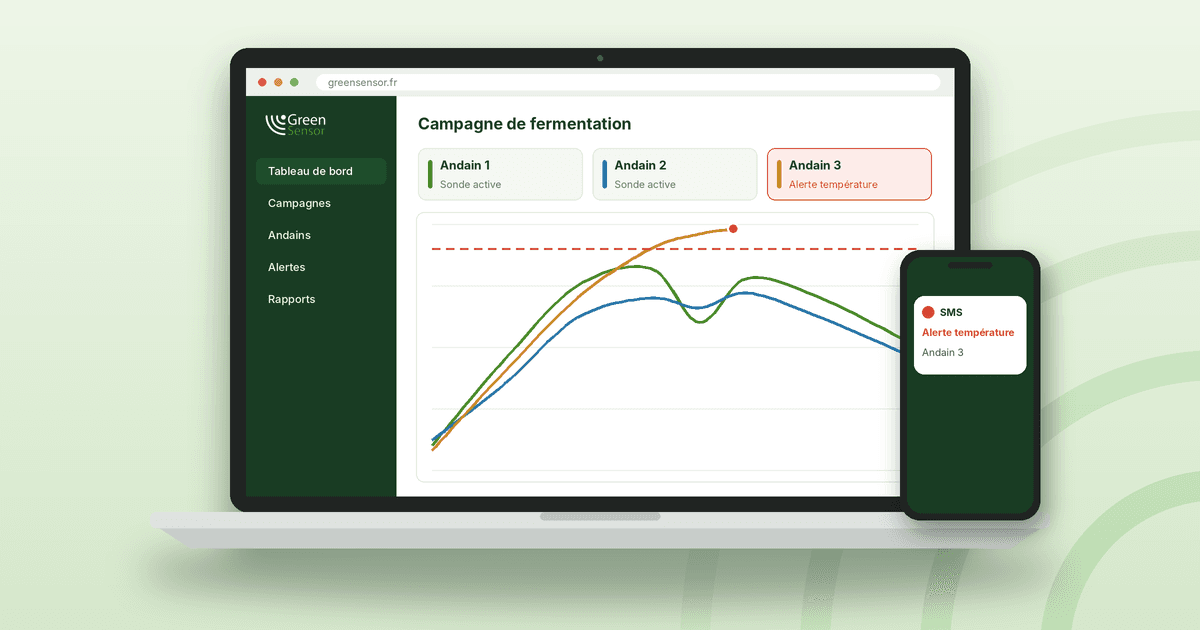
The GreenSensor probe measures the core temperature of the pile and the air temperature every hour. On the curve, a pile that goes past its usual plateau and keeps rising can be spotted before it reaches a critical level. The air temperature helps tell internal heating from a weather effect.
You set an alert threshold, for example between 80 and 85 °C: above the normal range of 50 to 70 °C, at the level where the BARPI recommends opening and watering the pile. As soon as it is exceeded, an SMS or e-mail goes to the people you choose, including at night and at weekends, when nobody is on site.
Place the probes where the risk is highest: mature compost stocks, screening rejects, the largest windrows. On a large windrow, plan several probes. During a heatwave or a spell of strong wind, the curves let you follow the sensitive piles without adding rounds. During an inspection, the history shows that temperature was monitored.
The most frequent cause of compost fires is heat building up at the core of the pile. Measuring that temperature continuously and being alerted above a threshold leaves time to open, water or turn the pile before it catches fire.

¿Un proyecto de seguimiento de temperatura?
Un asesor de Prosensor le presenta GreenSensor y responde a sus preguntas.